


Bringing water back to Bialowieza Forest: the way for resilient landscapes and community benefit
The project aims to restore the natural water retention of watercourses and return drained peatlands to a proper condition in the Polish part of the Białowieża Forest – the largest and best-preserved lowland primeval forest in Europe.
These actions will reverse the effects of past drainage of wetlands and river regulation, help preserve the forest’s unique biodiversity, and increase its resilience to drought, bringing benefits to local communities through improved ecosystem services. The project will serve as a model for large-scale ecological restoration and support the protection of a UNESCO World Heritage site.
What issue does the project aim to solve?
The Białowieża Forest is a wetland landscape, where peatlands and swamp forests cover up to 15% of the area. Over the past two centuries, human activity has significantly affected its ecosystems. Hydrological modifications began with the straightening of rivers for timber transport, followed by the drainage of peatlands to improve habitat conditions for wildlife, especially the European bison.
During the Soviet period, up to 49% of peatlands were drained, including extensive areas on the Belarusian side. These actions lowered groundwater levels by 0.4 – 1.5 meters, negatively impacting ecosystem processes and, for example, contributing to mass outbreaks of the European spruce bark beetle.
Recent climate changes – marked by rising temperatures and reduced snow cover – have further intensified water deficits in the landscape.
What are the project’s goals?
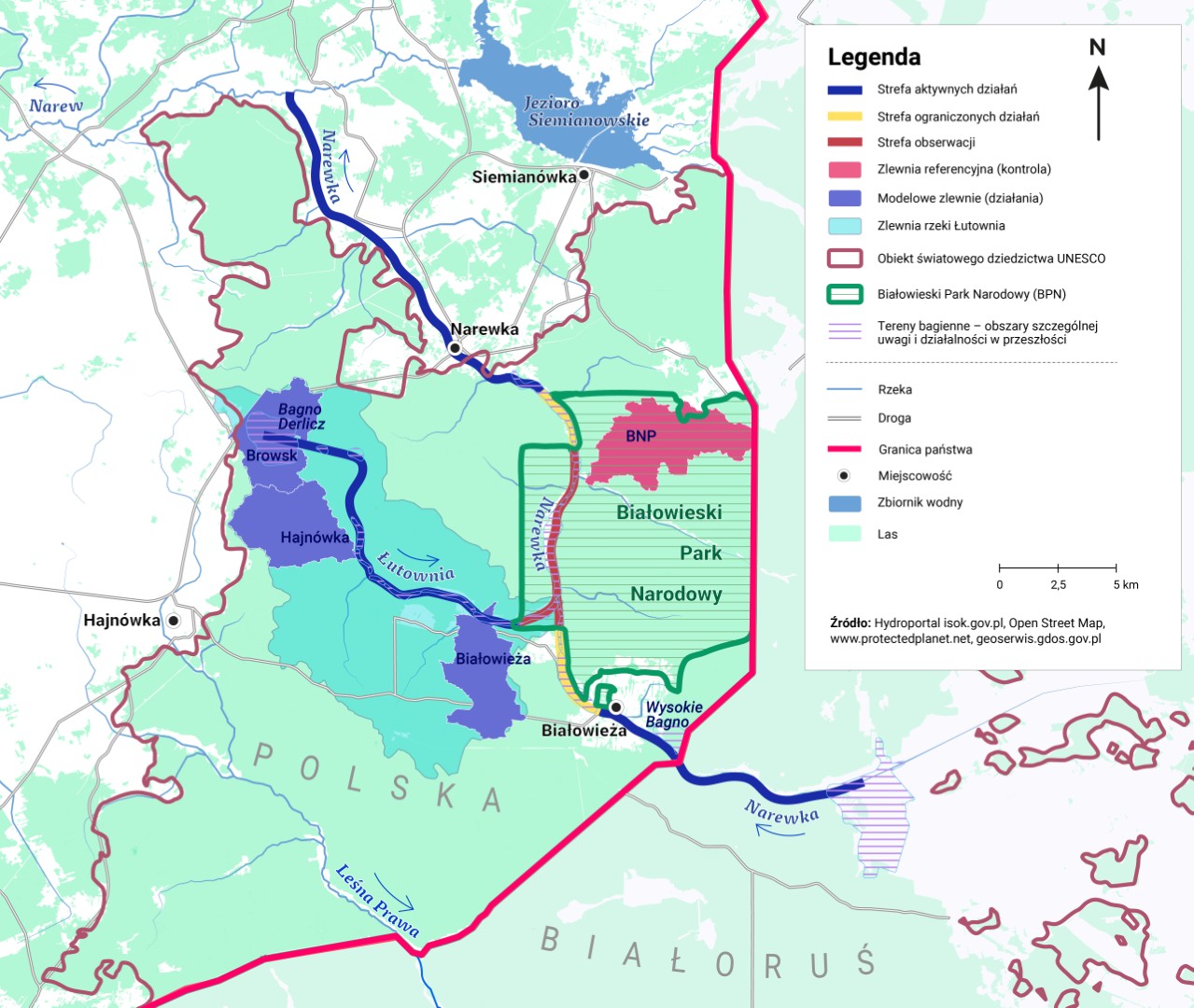
Our main goal is to restore the natural character of selected sections of the Narewka and Łutownia rivers and their catchments. We want water processes in the Białowieża Forest to once again function as close to natural as possible.
The map below shows the project area with designated activity and observation zones.
Equally important is strengthening understanding and awareness of the need for hydrological restoration. We want local communities and key stakeholders to recognize the value of healthy ecosystems and the benefits they provide.
The project will include open meetings, guided walks, field visits, study tours, and educational campaigns. We will also run field-based activities for pupils, students, and guides, and prepare educational materials for tourists in the Białowieża Forest region, ensuring the knowledge gained is widely accessible.
In addition, we will carefully monitor the results of our actions to track environmental and social changes both during the project and in the longer term.
We aim for the hydrological restoration model developed in the project to serve as a catalyst for further initiatives and for attracting funding to continue restoring natural water processes.
Who is implementing the project?
The project is being implemented by the Polish Society for Bird Protection (Polskie Towarzystwo Ochrony Ptaków), in partnership with the Białowieża, Browsk, and Hajnówka Forest Districts, the Regional Directorate of State Forests in Białystok, Białowieża National Park, and the Frankfurt Zoological Society.

When is the project planned to start?
The five-year project was launched in April 2026
Who is funding the project?
This project is supported by the Endangered Landscapes & Seascapes Programme, managed by the Cambridge Conservation Initiative in partnership with Arcadia.
The project budget is USD 4,6 million.

How can I support the project?
You can support the project by participating in volunteer camps. Volunteers help block drainage ditches and temporary watercourses in selected areas in the Białowieża Forest. Information about volunteer recruitment is published on the social media channels of the PTOP.
